What are the research topics of Dudziec Group?
The overall goal of the main research topics of Dudziec Group  is to understand and, for this, to design methodologies to obtain organosilicon/germanium compounds for further applications. Among them are specific organosilicon architectures, i.e. silsesquioxanes (SQs, POSS®) of general formula (RSiO3/2)n. They contain well-defined, 3D inorganic Si-O-Si core with organic coronae (R) of nanometric size are of our exclusive concern.
The expertise and skills of our Group are in preparative chemistry, i.e. inorganic and organic synthesis, which we apply to obtain functionalized silsesquioxane-based derivatives. In many cases, they are precursors to be applied in further studies. The research topics of the Dudziec Group may be divided into three main fields of interest.
1. Design and synthesis of molecular, functionalized silsesquioxane-based derivatives
Among the variety of structures, the scientific focus of our research is fixed mainly on three types of structures, i.e.
- functionalization of cubic T8 and ‘open-cage’ trifunctional T7 SQs derivatives
- design and synthesis of ‘closed’ core double-decker (DDSQ) type silsesquioxanes, described as D2T8 (di-DDSQ)
- design and formation of ‘open’ core DDSQ, described as M4T8 (tetra-DDSQ).
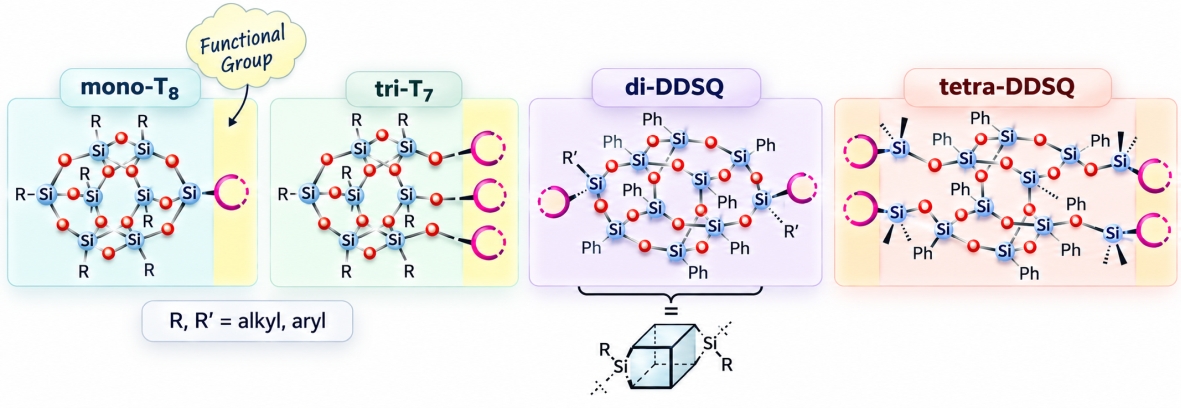 The research topics of Dudziec Group are focused on seeking a proper reactive moiety (FG=Functional Group) to attach it to the silsesquioxane core. This, in turn, enables the elaboration of the respective methodology its modification. As a result, more complex functionality is anchored to the Si-O-Si core that affects further appliance of these SQs systems.
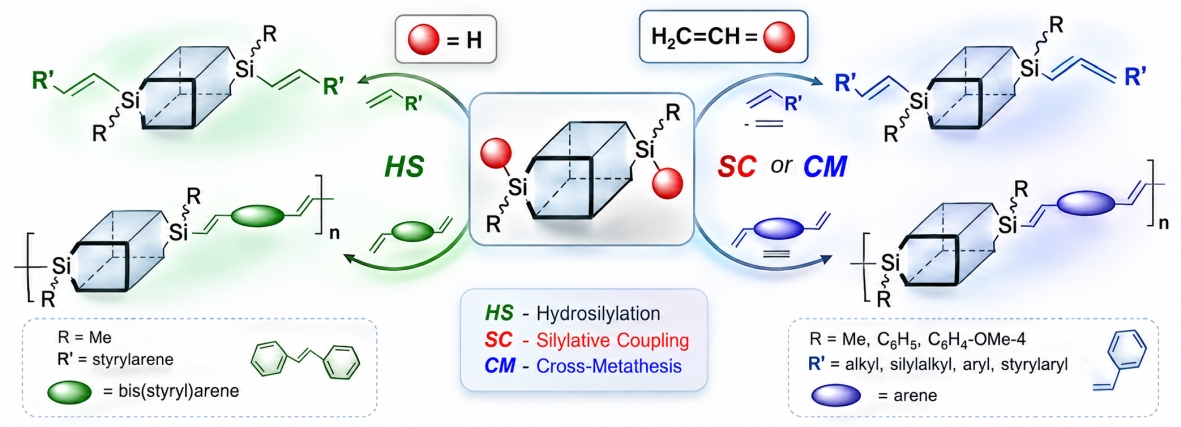
2. Formation of silsesquioxane-based systems of macromolecular architecture
The uniqueness of these hybrid systems results from the presence of an inorganic siloxane Si-O-Si core and tunable functional organic groups that classify them as hybrid systems. These compounds attract much attention due to their unique physicochemical properties. They are derived from chemically and thermally robust organic-inorganic frameworks and tailor-made structures. This bottom-up approach towards the formation of desired SQ derivatives has been of wide interest. This is due to the ability to modify both cubic T8 and DDSQ moieties with various functional groups of simple and complex architecture via mainly TM-mediated reactions. These include several types of processes, e.g. Heck and Sonogashira coupling, dehydrocoupling polycondensation, O-silylation, Friedel-Crafts reaction with the greatest influence of hydrosilylation, cross-metathesis, and silylative coupling. However, there has still been a limited number of scientific reports concerning double-decker silsesquioxanes in comparison with the cubic T8 structures.
3. Application of functional silsesquioxanes as polymer modifiers and nanofillers – advanced materials
The physicochemical properties of functionalized silsesquioxanes are a particularly important aspect of the research on their synthesis. This is due to their chemical and spatial structure, resulting in a hybrid, i.e. inorganic-organic nature. The presence of a regular element of the structure, i.e., a Si-O-Si core that corresponds to the silica structure, defines silsesquioxanes as fillers (nanofillers) with a perfectly defined structure and nanometric dimensions for polymer modifiers. Their well-defined molecular sizes and the presence of different amounts and types of functional groups at the POSS core allow their application for the precise deposition/embedding in the polymer matrix. As a result, new advanced composite materials with unique properties are obtained.
How to modify polymer matrix with silsesquioxanes
The synthetic procedures for introducing SQs into the polymer structure depends on the chemical nature of their FG (inert or reactive) as well as their amount. The applied methodology includes “grafting” of polymer matrix with monofunctional silsesquioxanes, copolymerization of organic monomers with di- or octafunctionalized SQs resulting in linear or 3D networks. The obtained hybrid materials exhibit a whole range of interesting physicochemical parameters, i.e. thermal, mechanical, optical and also chemical.
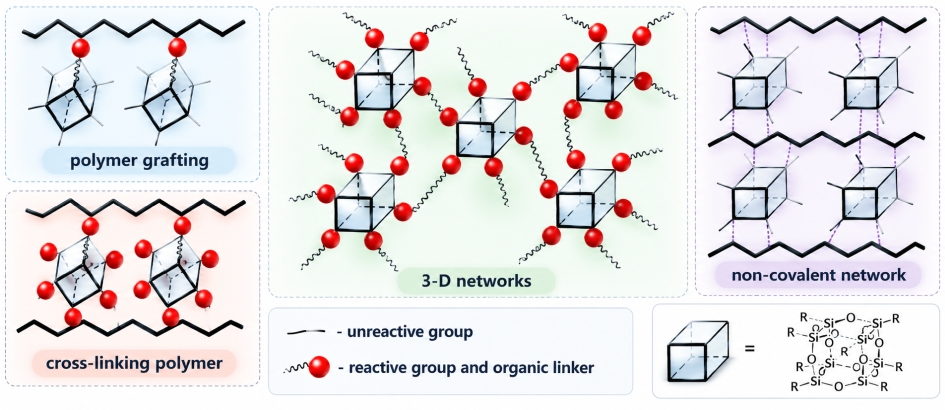
Directions of applications of functional silsesquioxanes and related hybrid materials
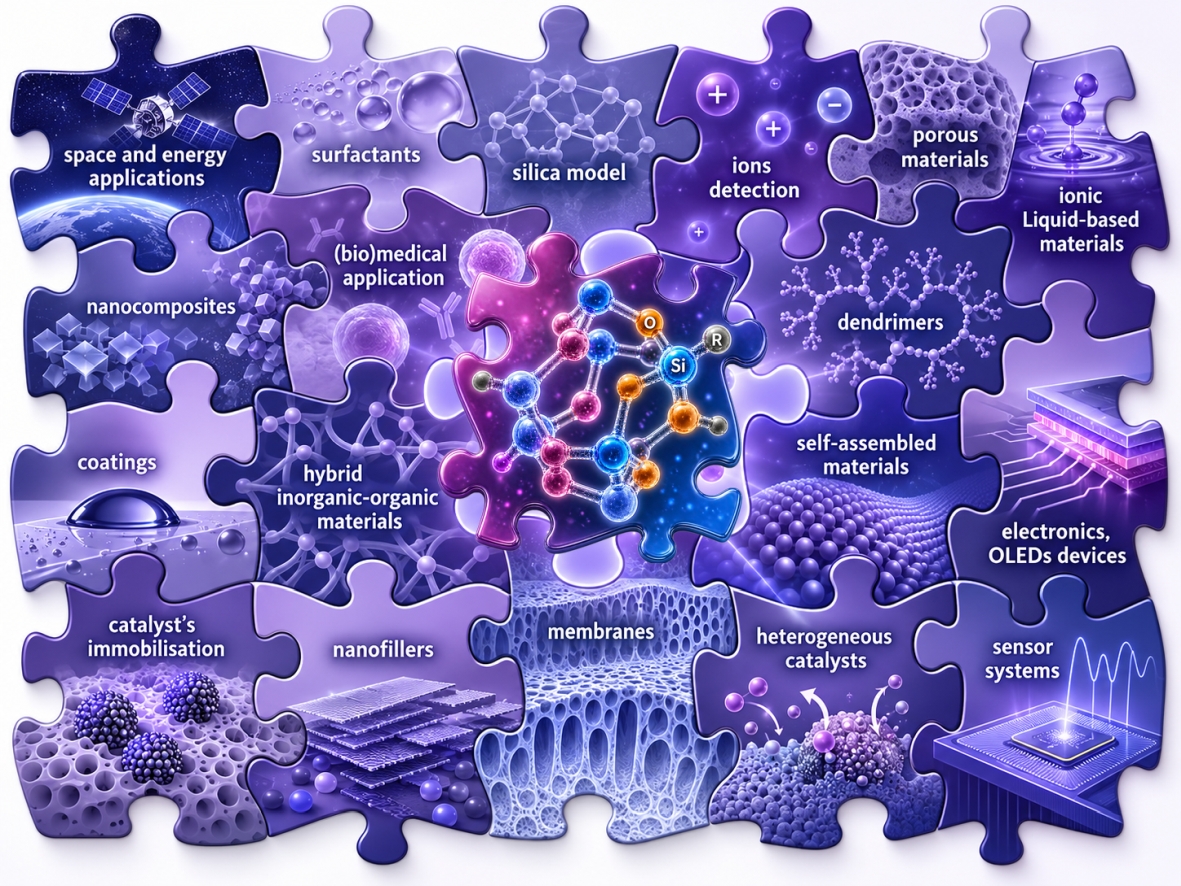
The properties of SQs-based materials are related to the synergistic combination of the features of their components. It is related, i.a. to solubility change, an increase of decomposition and glass transition temperatures, improvement of dielectric and/or oxidation properties and fire resistance, reduction of heat transfer coefficient as well as the hardness of obtained materials. Due to these aspects, the functional silsesquioxanes possess great application potential and may be utilised in many branches of chemistry, from materials (incl. opto- and electroluminescent systems), catalysis to biochemistry or medicine.
For a more thorough description of the research topics of the Dudziec Group, click publications.