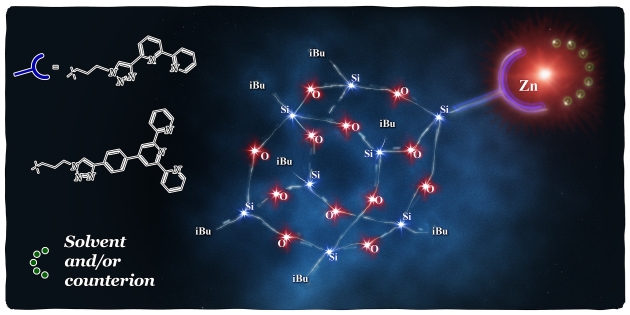
We are pleased to share our latest publication in Journal of Materials Chemistry A entitled “Silsesquioxane-based κ³-N,N,N pincer platforms for stoichiometry-controlled Zn coordination and tuneable emission via a click-and-catch strategy.” A new family of well-defined POSS-based tridentate pincer ligands designed for controlled Zn²⁺ coordination is presented.
Congratulations to all co-authors!
By combining the precision of click chemistry with the structural rigidity of an organosilicon cage, we demonstrate a “click-and-catch” approach that enables stoichiometry-dependent complex formation and modulation of interesting emission properties. This study highlights the potential of silsesquioxane cages as active molecular platforms for the design of functional hybrid coordination systems and luminescent materials. This publication is the result of a challenging and highly interdisciplinary research effort, requiring extensive synthetic work, careful optimization, and a broad range of complementary analytical techniques. Particular attention was devoted to photophysical studies, which played a crucial role in understanding how the coordination environment, ligand architecture, and metal-to-ligand stoichiometry influence the emission behavior of the resulting hybrid systems. Detailed spectroscopic, crystallographic, and photophysical analyses allowed us to gain deeper insight into the structure–property relationships governing these POSS-based Zn²⁺ complexes. The study highlights the potential of silsesquioxane cages as active molecular platforms for the design of functional hybrid coordination systems and luminescent materials
Congratulations to all co-authors!
M. Rzonsowska, A. Kaniewska, J. Szymkowiak, K. Mituła-Chmielowiec, B. Dudziec
Silsesquioxane-Based κ³-N,N,N Pincer Platforms for Stoichiometry-Controlled Zn²⁺ Coordination and Tuneable Emission via a Click-and-Catch Strategy
J. Mater. Chem. A. 2026 (accepted), DOI: 10.1039/d6ta03881f