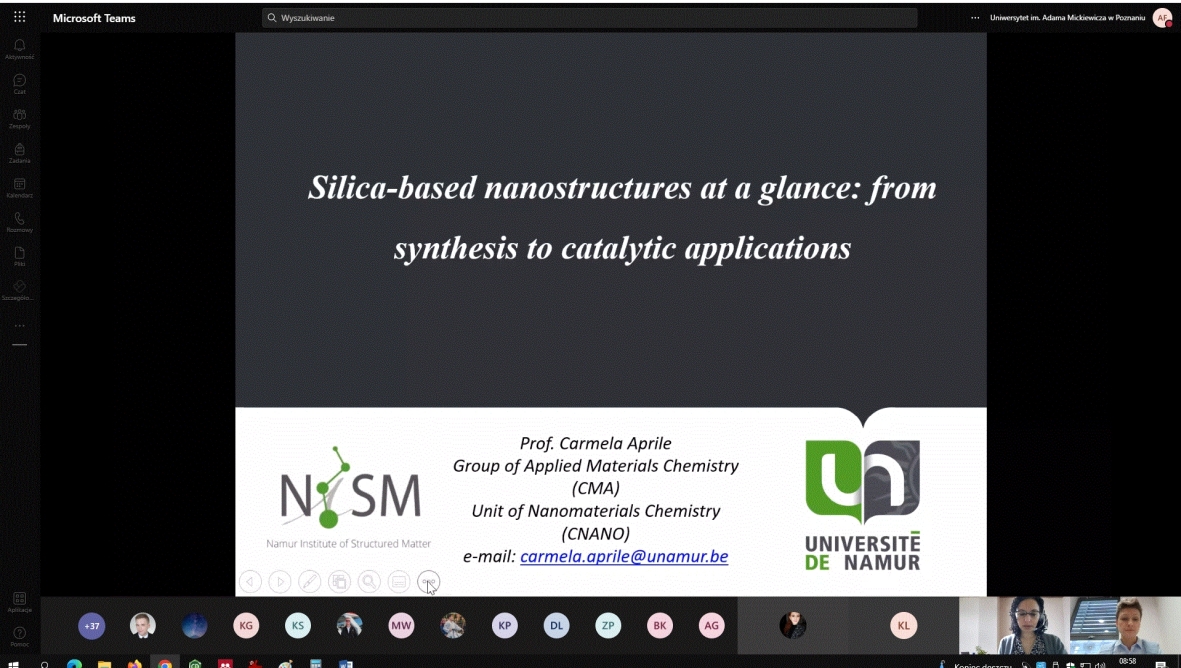
Last week, April 8th at Faculty PhD Seminar we had a chance to listen to a guest online lecture given by Prof. Carmela Aprile from the University of Namur (Belgium). Its title: “Silica-based nanostructures at a glance: from synthesis to catalytic applications”. Prof. Aprile is a reputable expert in the area of material science. Her scientific interests concern different fields of materials, including mesoporous systems, organic-inorganic hybrid solids and their characterization that in particular pays attention to solid-state nuclear magnetic resonance. She is also interested in heterogeneous catalysis and its use in sustainable chemistry. We have ongoing scientific cooperation.
This was a great and very inspiring great 1-hour journey via the chemistry of porous materials based on silica. Take a look at the abstract:
“(Nano)structured porous silica-based solids are an important class of materials possessing high specific surface area, large pore volume, easily tunable porosity and rich surface chemistry. A widespread number of applications have already been proposed in the domain of adsorption, pollutant remediation, sensors, drug delivery and catalysis. The importance of all-silica materials is further enhanced by the possible functionalization of the surface as well as by the selective isomorphic substitution of silicon with different metal cations. Both approaches constitute a key pillar in material science significantly enlarging the range of applications including the ones related to catalysis.
The present seminar will address the fundamental aspects of some of the most important synthesis procedures and recent insights on the mechanism of formation of silica-based nanostructured materials together with a general overview of applications (mainly in catalysis). Selected case studies on various heterogeneous catalysts and functionalized silica-based materials will be proposed with a special focus on sustainable applications such as CO2 conversion and biomass valorisation.”