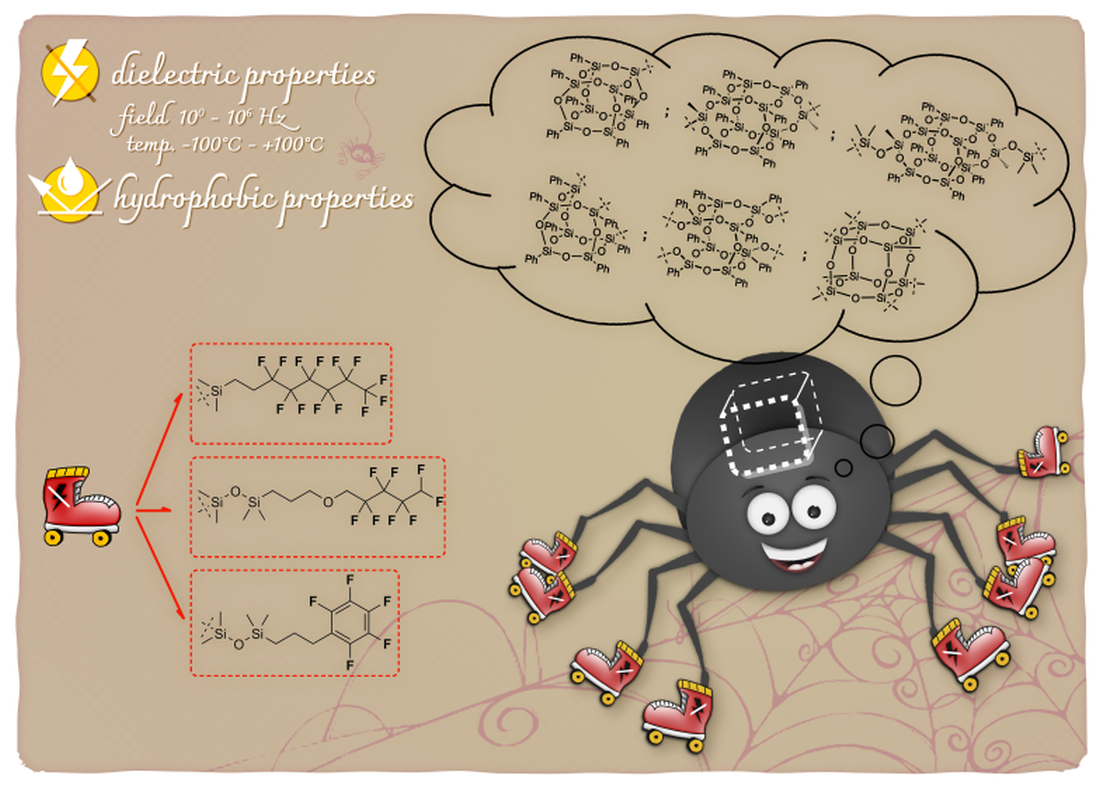
 Just before Christmas a paper was published on smart and efficient methodologies for the synthesis of a variety of fluorinated silsesquioxanes (SQs) with diverse Si-O-Si core architecture. It’s a paper from Julia’s PhD Thesis. This protocol is based on an easy-to-handle and selective hydrosilylation reaction. We investigated the impact of the placement of the reactive Si-HC=CH2 vs. Si-H group in the silsesquioxane, as the structure of well as silane versus olefin on the selectivity of the process.
Interestingly, the samples susceptible to the form of pellets or thin films deposited on steel plates were subjected to dielectric permittivity measurements. It was noticed that fluorosubstituted groups insensibly decrease the value of dielectric permittivity for solid samples that were verified in a wide range of temperatures (from −100 °C to 100 °C) and electric field frequencies (100–106 Hz).
Look for yourself:
J. Duszczak, K. Mituła, M. Rzonsowska, P. Ławniczak, R. Januszewski, B. Szarłan, B. Dudziec
Slick Synthetic Approach to Variously Fluoroalkyl Silsesquioxanes – Assessment of their Dielectric Properties
Materials, 2022, 15, 8997. DOI:10.3390/ma15248997